Monday, 31 March 2014

Cliché introduction and Iwo Jima flag raising


A cliché in popular media is an image or idea that gets used to the point where it is dumbed down or it’s original point doesn’t apply anymore clichés can include stereotypes and phrases and imagery that are used extensively, typically in comics or works of fiction.

The raising of the American flag on Iwo Jima during WWII is an iconic image of the time it was the only photograph to win the Pulitzer prize for Photography in the same year as its publication, it has also been used as reference to sculpt the 1954 marine corps war memorial, there is no doubt that it is one of the most famous war photos in history, however over the years many artists in popular media have used the image in there own crafted scenarios and with there own characters. It has been used with Lego figures, on etch a sketches, in corn mazes, even in butter, in innumerable newspaper cartoon illustrations and in at least six Simpson’s episodes. The image is popularly used by organizations or movements wishing to convey victory, teamwork, or patriotism. The use of the image has ranged from respectful homage to what some consider offensive misappropriation”(7). The general reaction to parodies of the image vary, with veterans and soldiers generally being displeased or angry with it’s use in media, one such case was when Times magazine used the famous image but replaced the flag with a tree for an issue about global warming. The image has also inspired a book and then also the film by the same name “flags of our fathers” which was directed by Clint Eastwood. The image has also been used by many people to convey thoughts of patriotism or joint views of a cause, however it can also be used to show the opposite if used in the correct terms for example anti war activists in the 1960’s altered the flag to bear a peace symbol as well as several anti establishment artworks.


(7) “Raising the flag on Iwo Jima”: the most reproduced and parodied photo in history?

Damsel in distress


The damsel in distress character portrayed in popular media is to all intents a plot device, most usually a beautiful woman held captive by a villainous character and the hero must go and save her. Princess peach from the Mario series is a classic example of the damsel stereotype. She has the following characteristics that set her up as a damsel: She is of royal descent, most damsels in mythology or folklore tend to be of royal blood, she is captured by the villain (bowser in this case) and taken of to his lair. This sets in motion for the hero (Mario) to go in a quest to save her, Mario must then go through stages until reaching the final boss, the term “your princess is in another castle” used in media to add another problem to the supposed end of the story “derives its name from Super Mario Bros., where all but the final castle level, a rescued toad thanks Mario but tells him “our princess is in another castle.”(6) Also in popular media she is also known as Mario’s girlfriend furthering the hero must save his beloved story arc prevalent in a lot of European fairy tales such as sleeping beauty, Rapunzel and snow white, who are all in “distress” until a dashing prince comes to save them.


(6) tvtropes.org/pmwiki/pmwiki.php/Main/YourPrincessIsInAnotherCastle?from=Main.OurPrincessIsInAnotherCastle

Sidekick


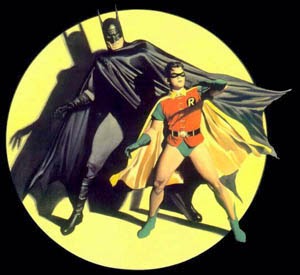
The sidekick is usually of a younger age than the senior hero and in many cases is a teenager or only slightly older, the general use of sidekicks such as Robin, from batman and robin seen above is to be “a counterpoint to the hero” (5) either performing comic relief to lighten darker moods in comics as is the case with Robin, or to counterbalance the heroes powers or style as is the case with S.T.R.I.P.E who is one of the few sidekicks who is older than the teenage hero and performs the role of protector for the physically weaker hero. Robin the wonder boy, is renowned as DC comics first teenage sidekick, who’s main job in the famously dark comic book seroes was to lighten the mood and add a sense of humour to the series, so as  “to soften up the gritty Detective Comics’ stories of Batman. The character was an instant hit with young readers”(5) this led to a large boom of comic book teenage sidekicks until superhero comics began to lose popularity in and around the 1950’s until they made a comeback in the comic books “silver age” in the early 1960’s. in other media the sidekick follows much the same format helping the hero and performing a somewhat lighter tone on events, there are sidekicks in such classics as Don Quixote with Sancho Panza and Doctor Watson in Sherlock Holmes, each of these characters and sidekicks in general are there to shore up certain shortcomings of the protagonist/hero.


(4) McNamera, Mary

(5) Jones, Geppetto. "Snuff, Sidekicks, and the Apocalypse Suite," http://archive.is/MgJUq#selection-493.61-493.172

Villain


Random House Unabridged Dictionary defines villain as "a cruelly malicious person who is involved in or devoted to wickedness or crime; scoundrel; or a character in a play, novel, or the like, who constitutes an important evil agency in the plot" A villain or antagonist is generally the main opposition of the hero in a tale they may be a single person or an institution. Vladamir Propp, stated in his book Morphology of the Folk Tale (4) that a fairy tale had eight Dramatis Personae (or characters in story) one of which had to be the villain, this character was usually recognized by certain actions that were performed these were:
·      a story-initiating villainy, where the villain caused harm to the hero or his family
·      a conflict between the hero and the villain, either a fight or other competition
·      pursuing the hero after he has succeeded in winning the fight or obtaining something from the villain
Jafar from Disney’s Aladdin is a good example of a classic villain character he portrays many of the stereotyped visual cues of villains such as a thin moustache a cackling laugh and a thin figure exemplified by Tod Slaughter a famous actor on both stage and screen that portrayed many villainous characters and was one of the main influences on the stereotype villain character. Jafar also fits two of the factors set out by Propp, these are A conflict between the hero where both are trying to marry the princess, and the pursuit of the hero after he has won by the fact that he is the villain in the second Aladdin film after he lost in the first one.


 (3) Vladimir Propp p 79